
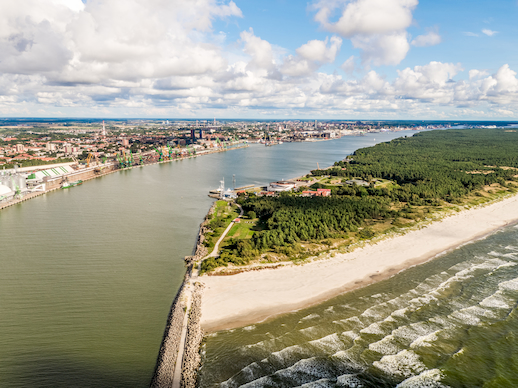
About the place
Smiltynė is the northernmost and one of the oldest settlements on the Curonian Spit. It was first mentioned in 1429 as Sandberg – “Sand Hill” – and was later renamed Sandkrug, meaning “Sand Inn”. The name Smiltynė came into use in the 20th century. From the 19th century onward, Smiltynė became increasingly popular as a resort area, attracting holidaymakers with its beautiful natural surroundings, clean beach sand and walking paths.
Kopgalis is the youngest part of the Curonian Spit, as the strip of land here continued forming until the mid-19th century. For a long time, the pointed tip north of Smiltynė had no established name. The Germans later called the area Suderhuk, Suderhaken and, later still, Suderspitze (“southern cape” or projecting point). The Lithuanian place name Kopgalis is linked to the Klaipėda Region Lithuanians’ name for the spit – Kopos – and became established by the end of the 19th century.
Here is a self-guided route for discovering Kopgalis:
1. As soon as you arrive in Smiltynė, you will see the planted dune known as “Sandkrug”. This was once the site of the last postal station on the Curonian Spit, together with an inn offering rooms to travellers. It was not the first location of the postal station – the earlier one stood closer to the lagoon. Today the former inn site is known as the “Smėlio karčema” hill.
2. Smiltynė Kurhaus is an impressive two-storey hotel with an attic, built in 1900. With its massing and distinctive architecture, it remains a strong landmark in the southern part of Smiltynė. The hotel had 50 rooms; guests could enjoy warm baths and use the latest invention – electricity. A restaurant operated in the garden and a café stood on the lagoon shore. The Kurhaus features half-timbered architecture reminiscent of some buildings in Klaipėda Old Town. Before the Second World War it was an important cultural centre in Smiltynė, hosting music evenings and recitals by noted performers of the time, and even offering roulette. During the first post-war decade the building was converted into apartments. Later, as Smiltynė’s recreational importance grew, the residents were relocated and a branch of the “Klaipėda” hotel and the “Smiltynė” café were opened here.
3. The Smiltynė wellness trail was created in 1989 on the initiative of Algimantas Laurinaitis. Its aim was to encourage more people to spend time actively and healthily while also protecting the Smiltynė forest from fires. Everything here is natural and made of wood. The trail was renovated in 2012 and is open to visitors.
4 and 5. These are the most popular beaches in Smiltynė.
The wide beaches of white, soft and even squeaky sand attract many holidaymakers throughout the summer. Their generous width makes them suitable not only for swimming and sunbathing, but also for beach volleyball, tennis, frisbee and other active games.
6. Surviving defensive fortifications: “Jachmann”, also known as “Memel Süd”. This coastal defence battery was named after German Vice Admiral Eduard von Jachmann and was built in the spring of 1939. The site is often described as “lost” and for a long time received little attention. Its four 150 mm SKL-45 naval guns were installed only on temporary concrete platforms. Nearby, a two-storey bunker serving as a fire-control post was also built. The bunker is currently in poor condition and is not adapted for visitors.
7. The entrance to the Port of Klaipėda is formed by the southern and northern breakwaters. These structures protect the harbour basin from waves, drifting ice and sediment. Klaipėda has two parallel breakwaters: the southern one is 1,227 m long and the northern one 1,158 m. Both were built on deeply driven piles, with the above-water sections constructed of stone. As the port was deepened, the breakwaters were reinforced with stones and large concrete blocks.
The northern breakwater was built between 1834 and 1884, while the southern one was constructed between 1847 and 1861. Their function is to direct the current from the mouth of the Danė River into the Baltic Sea and protect the navigation channel from silting.
Both breakwaters are popular walking spots, where residents come to watch sunsets and ships entering and leaving the port.
8. Lithuanian Sea Museum and Dolphinarium. In 1994, the only dolphinarium on the eastern Baltic coast was opened here. It is home to Black Sea bottlenose dolphins, mammals belonging to the toothed-whale suborder. The dolphinarium hosts lively educational programmes that introduce visitors to some of the sea’s most intelligent mammals. Since 2001, the Lithuanian Sea Museum Dolphinarium has also run a special dolphin-assisted therapy programme for children with various health conditions.
9. Nerija Fort. In the second half of the 19th century, a coastal defensive fortress – Nerija Fort – was built in Kopgalis. It was almost completely destroyed during the Second World War. In 1979 the fort was restored and adapted for museum use. The posterns and casemates beneath the ramparts now house an exhibition on the history of Lithuanian navigation, while a collection of historic and modern anchors is displayed on the ramparts in the former gun positions. The museum collects, preserves, studies, restores and presents objects reflecting Lithuania’s maritime history and the diversity of marine nature. Today visitors can walk through this historic fort themselves.
10. “Albatross” – a monument to sailors who lost their lives and to sunken ships. The names of tragedies and victims, whether forgotten over the centuries or preserved in memory, remind us of the dramatic relationship between people and the sea.
Above the graves of those who never returned from the sea, gulls and albatrosses circle – birds in which, according to legend, the souls of sailors are reborn.
The monument is intended to unite the maritime community. It has become a symbol of Lithuania as a maritime nation and of Klaipėda as its maritime centre.
The metal bird rises in flight, carrying the hope that the memory of those lost at sea will remain alive in the hearts of Klaipėda residents and sailors.
(Authors: sculptor Klaudijus Pūdymas and architect Mindaugas Zabarauskas.)
11. The ethnographic seaside fisherman’s homestead was established in 1979. It was created after the model of fishermen’s homesteads from the Šventoji and Palanga coastal area dating from the late 19th and early 20th centuries. Such farms usually consisted of only two or three buildings. Here you can explore both residential and utility structures. The complex represents the homestead of a relatively prosperous fisherman who kept livestock, worked the land and fished. It includes a dwelling house, barn, granary, sauna, cellar, smokehouse and poles for drying nets and fish.
12. The veteran-vessels exhibition area displays fishing boats including the trawler “Dubingiai”, the small fishing trawler “Kolyma” and a steel trawl boat (PTB-7167). These vessels operated not only in the Baltic and North seas, but also in the Atlantic Ocean.
You can also see the famous kurėnas “SüD.1”. These flat-bottomed sailing boats were used for fishing in the Curonian Lagoon until the 1950s.
13. The small Kopgalis village cemetery in Smiltynė was used in the 19th and early 20th centuries. Residents of Smiltynė and Kopgalis are buried here, including Lithuania’s first sea captain Liudvikas Stulpinas (1871–1934) and the poet, publicist and governor of the Klaipėda Region Jonas Žilius-Jonila (1870–1932).
14. In order to ensure constant maintenance of hydraulic structures – the breakwater, groynes and loading piers – improve ballast unloading and control the sand at the tip of the spit, the Klaipėda city authorities settled permanent residents in Smiltynė. They spoke Curonian-German or Curonian-Lithuanian-German. By the second decade of the 20th century, most residents of Kopgalis worked in the city.
By 1821 there were already seven homesteads here. Residents unloaded ballast, reinforced the shore, covered it with turf, fished and grew potatoes.
Even today, old villas with elements of folk architecture can be seen in Smiltynė. Some are entirely wooden, while others are half-timbered. The surviving Smiltynė villas date from the early 20th century.