
About the activity
Text by Laurencija Budrytė–Ausiejienė.
We have ten minutes until the next stop, so let us use the time to explore the origins of another Klaipėda “gem” – the University Botanical Garden. We will talk about its plant collections and its links with the Prussian royal family. As before, remember that we orient ourselves by whether the sights lie on the right or left bank when looking in the direction of the river’s flow.
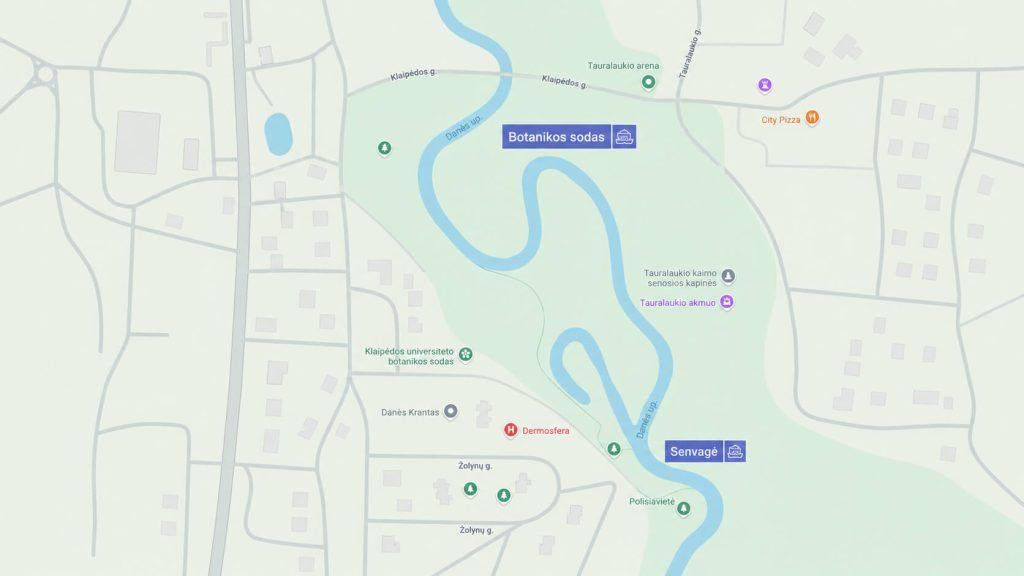
When Klaipėda University was established in 1991 and study programmes in biology, ecology and recreation were created, a research base became necessary. For this purpose, the Klaipėda University Botanical Garden was founded in 1993 in the valley of the Dangė, on the right bank of the river, on the former lands of the Great Tauralaukis Manor. The total area is 9.3 hectares and the Baltic Sea is 3.5 kilometres away. The Botanical Garden is remarkably productive: it collaborates with botanical gardens in Lithuania and around the world, exchanges seeds and green cuttings and maintains a seed collection of cultivated plants. Almost 5,000 plant specimens grow in the garden, including more than 250 species occurring naturally. Five collections are being developed and continuously expanded: dendrological plants; medicinal and aromatic plants; herbaceous ornamental plants; Eastern gardens; and Lithuanian flora. There is also an ethnographic flower garden, while a unique collection of dune plants introduces visitors to the distinctive flora of the coast. The herbaceous and ornamental plant section is developing displays of roses and bulbous plants. One of the garden’s particular treasures is Ginkgo biloba, a relict tree from Japan that is rarely encountered in Lithuania. The garden lies in an area with distinctive climatic conditions: compared with many other parts of Lithuania, temperatures are higher, precipitation is greater and the growing season is longer. In 2000 the Botanical Garden was declared a protected natural site.
The garden was established on the lands of the Great Tauralaukis Manor, and the manor cemetery has survived here. Among those buried is the nobleman Evald von Mirbach, former owner of the estate and one of the founders of Klaipėda’s Masonic lodge “Memphis”. His grave is marked by a stone stele with an inscription. Another important heritage feature in the Botanical Garden is a surviving section of a historic road. Numerous old oaks, maples and ashes also remain, recalling Prussian history and even the famous walks of Queen Louise. It is said that while residing in Memel she would travel to Tauralaukis by carriage or boat with her children and enjoyed picnics beneath the oaks. Today, such royal pleasures are open to everyone. The renewed garden offers illuminated educational paths adapted for visitors with reduced mobility, a smart plant-labelling system, interactive information boards, stylish gazebos and cosy rest areas for those seeking peace and beauty. In this garden full of life and colour, beneath historic trees, people arrange memorable dates; before Christmas they hurry here to choose the most beautiful fir trees; and dedicated plant lovers enrich their collections by purchasing plants grown in the garden. By the way, did you know that on 18 May the world celebrates Fascination of Plants Day? It is a perfect occasion to visit Klaipėda University Botanical Garden.