
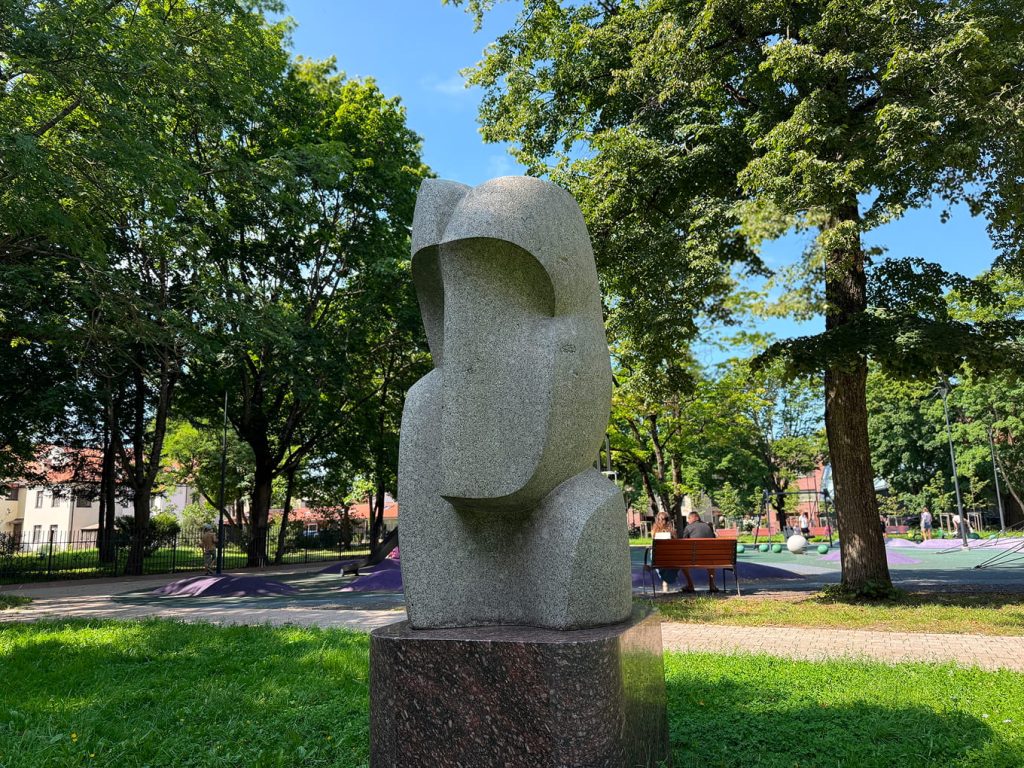
About the place
The sculpture quietly sings a partisan song:
If not for the golden summers / Nor blue cornflowers / We would not have come here / Where grey days drift / We would not have come here / Where grey days drift /
Passer-by:
– I hear a song my grandmother loved to sing. Why does it sound beside a sculpture whose title is written in Latin – “Ecce homo”? What do these words mean?
Sculpture:
– Ecce homo, Pontius Pilate said to the gathered crowd, pointing to Jesus crowned with thorns. Translated from Latin, Ecce homo means “Behold the man”.
Passer-by:
– My ten-year-old son said you look like a football team captain calling his mummy because he wants to complain about his aching leg.
Sculpture:
– I should not say your son is wrong. But since I know something interesting about my own birth, I will tell you about it.
Sculptor Vladas Vildžiūnas, who lived in Vilnius, was inspired to create a sculpture called “Ecce homo” by a performance of the same name by Latvian mime artist Modris Tenisons. Vildžiūnas admired Tenisons’s intellectual creativity and his attempt to explain the meaning of human suffering.
Vildžiūnas created as many as three “Ecce homo” sculptures. He carved the first at a symposium in Villány, Hungary, in 1972. In Klaipėda he repeated the same form, only twice as large. In Vilnius he cast two small bronze “Ecce homo” sculptures – one was acquired by a collector in America, while the other adorns the Vildžiūnas family home in Vilnius’s Jeruzalė district.
Passer-by:
– Now I can see that the person before me is not a football team captain.
If not for the golden summers / Nor blue cornflowers / We would not have come here / Where grey days drift / We would not have come here / Where grey days drift /